The painting
The Beheading, explained
A plain guide to Caravaggio's Beheading of Saint John the Baptist: what the scene shows, why it is so large, where he signed it and how to look at it.
Book the Caravaggio performance ↗Quick answer
The Beheading of Saint John the Baptist is Caravaggio's largest painting and the only one he signed. Finished in 1608 for the Oratory of St John's Co-Cathedral in Valletta, it shows the moment of the saint's execution in a bare prison courtyard, lit by a circle of light against deep shadow. The signature sits in the blood on the floor. It still hangs in the room it was painted for.
What you are looking at
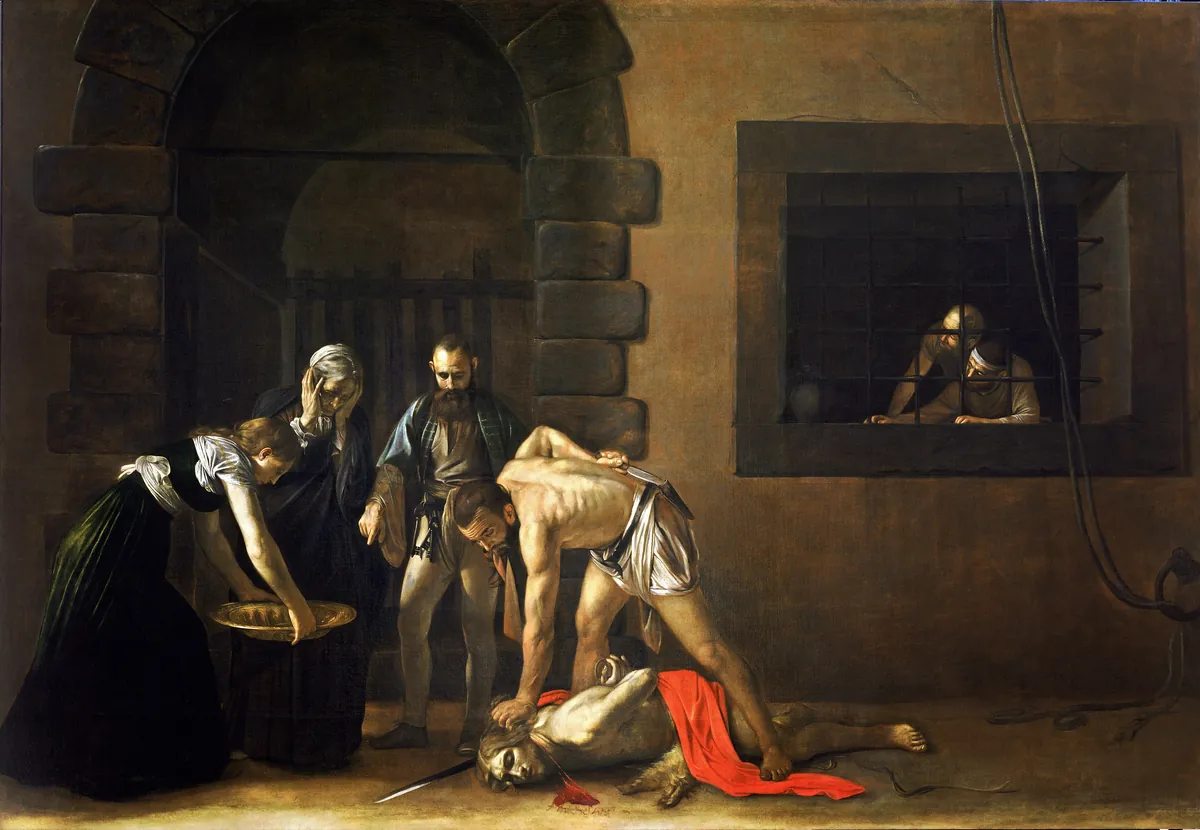
Wikipedia describes an oil painting of 3.7 metres by 5.2 metres that shows the execution of John the Baptist. Prominent are vivid red and warm yellow, common to the Baroque period, and the use of chiaroscuro. A servant girl stands with a golden platter to receive the saint's head. Another woman stands by in shock, a jailer issues instructions and the executioner draws his dagger to finish the beheading.
The scene and its source
Wikipedia says the scene was popular with Italian artists and with Caravaggio himself, and that it is not drawn directly from the Bible but from the tale as told in the Golden Legend, a medieval collection of saints' lives. It names the second woman as possibly Herodias or simply a bystander who realises the execution is wrong. It says the work is widely considered Caravaggio's masterpiece and one of the most important in Western painting.
Light and shadow
Wikipedia calls the painting one of Caravaggio's most impressive uses of chiaroscuro, with a circle of light illuminating the scene. The rest is shadow, and there is considerable empty space in the image, though the canvas is so large that the figures are approximately life-sized. Mattia Preti, who later decorated the cathedral's interior, became acquainted with the techniques of Caravaggio and his followers in Rome, and Wikipedia notes sharp contrasts of shadow and intense light in his early work.
The signature
It is the only work by Caravaggio to bear his signature, which he placed in red blood spilling from the saint's cut throat. Wikipedia says the signature became visible to modern viewers during restoration in the 1950s and is read as f. Michelang.o, the f indicating his brotherhood in the Order. It adds that the signature is a matter of dispute and that a popular story claims he signed in confession of a crime, which the article treats as a claim and not a fact.
Made for this room
Wikipedia says the painting was completed in 1608 in Malta, commissioned by the Knights as an altarpiece, and that it was the largest altarpiece Caravaggio ever painted. It still hangs in St John's Co-Cathedral, in the Oratory for which it was commissioned. The Oratory was begun in 1598 and finished in 1604, so the room was waiting for it. The article on the cathedral says the painting was restored in Florence in the late 1990s.
Read next: The cathedral and its Oratory
Where the prison might come from
Wikipedia says Caravaggio likely drew the background from memories of time in prison in Rome, or from study of the prison of the Knights of Malta, where he would coincidentally be detained after he finished this work. The barred window and the heavy stone arch give the courtyard the feel of a prison. The article presents this as likely and not proven, so treat it as an informed guess about where his images came from.
How the evening treats it
The booking page lists a viewing of the painting with the concert among its highlights, and mentions special lighting around the Caravaggio masterpiece. No particular lighting effect is promised here, since it can vary from night to night. The page does say that the music, the narrator and the painting are brought together in the Oratory, and that the cathedral can be viewed for 30 minutes beforehand.
Read next: Caravaggio concert in Valletta
A graphic subject
The subject is an execution and it is painted without softening. The image shows the saint on the ground, the blood, the dagger and the onlookers. Younger children may find it hard, and some visitors prefer to know before they go. The booking page gives no age guidance, so a parent has to decide. The evening presents it through music and narration, and the performance is in English. Check the confirmation for anything the producer adds about suitability.
Who this isn't for
This guide describes a painting and does not replace seeing it. It is not an art-history course, and it leaves out the painting's technical analysis and restoration reports. The evening performance is built around this canvas, so readers who dislike violent subjects in art may prefer a daytime visit to the nave and chapels instead. If you want a technical study, the cathedral's own publications and specialist books go much further.
Frequently asked questions
How big is the painting?
3.7 metres by 5.2 metres, according to Wikipedia. It is the largest canvas Caravaggio painted.
Where is the signature?
In the blood spilling from the saint's throat. Wikipedia reads it as f. Michelang.o, with the f for fra, brother of the Order.
Where does the painting hang?
In the Oratory of St John's Co-Cathedral in Valletta, the room it was painted for in 1608.
Was it restored?
Yes. Wikipedia says some restoration took place in the 1950s, and the article on the cathedral says it was restored in Florence in the late 1990s.
Where does the story come from?
Wikipedia says it comes from the Golden Legend, a medieval collection of saints' lives, and not directly from the Bible.
Sources